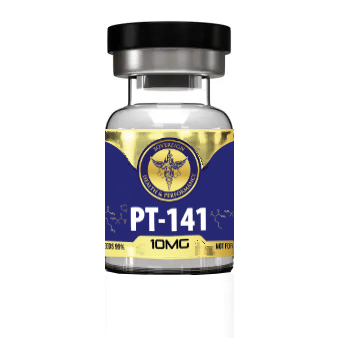
PT-141 Research Overview
PT-141 (Bremelanotide) is a synthetic peptide designed to interact with specific signaling pathways in the brain that regulate desire, motivation, and arousal.
PT-141 is not a hormone and does not act directly on blood vessels or peripheral tissues. Instead, research shows it works through central nervous system signaling, particularly within melanocortin pathways that determine whether arousal signals are initiated at all. 1-3
In preclinical and translational research, PT-141 has been shown to activate melanocortin receptors in the hypothalamus and limbic system—regions responsible for integrating motivation, autonomic tone, and behavioral readiness.2-5
Rather than forcing a physical response, PT-141 appears to modulate neural thresholds, allowing arousal-related signals to activate more readily in response to appropriate stimuli.3-6
Key Actions
- Activates central melanocortin receptors (MC3R, MC4R)1,2
- Enhances neural signaling related to desire and motivation3
- Lowers the threshold required for arousal signal initiation4-6
- Modulates autonomic nervous system balance5
- Operates independently of vascular or nitric-oxide pathways7
In short: PT-141 is a research compound that influences how the brain initiates arousal signals, rather than how the body executes them physically.
🧬 What Is PT-141?
PT-141 is a synthetic analog of α-melanocyte-stimulating hormone (α-MSH), a naturally occurring peptide involved in appetite regulation, autonomic balance, motivation, and sexual behavior.1,2
α-MSH is part of the melanocortin system, a central regulatory network that helps the brain assess internal conditions—such as energy status, stress, and emotional context—and translate them into behavioral output.2,4
PT-141 was engineered to selectively activate melanocortin receptors associated with sexual motivation and arousal signaling, particularly MC3R and MC4R, without engaging peripheral vascular mechanisms.3,7
Core Research Areas
- Central Arousal Signaling: Initiation of desire-related neural activity3,4
- Motivational Circuitry: Modulation of limbic and dopaminergic pathways5
- Autonomic Integration: Influence on hypothalamic autonomic control6
- Hormone-Independent Action: CNS signaling without endocrine modulation7
- Signal Sensitivity: Adjustment of responsiveness to arousal cues4
Molecular Details
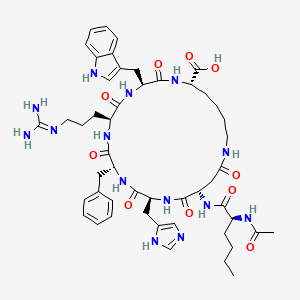
- Sequence: Ac-Nle-Asp(1)-His-D-Phe-Arg-Trp-Lys(1)
- Molecular Formula: C₅₀H₆₈N₁₄O₁₀
- Molecular Weight: 1025.182 g/mol
- Structure: Cyclic melanocortin-receptor agonist
- Primary Targets: MC3R and MC4R (central nervous system)1,2
- PubChem CID: 9941379
- CAS Number: 189691-06-3
- Mechanism: Central neural signaling modulation within hypothalamic and limbic pathways
Source: PubChem
🧠 PT-141 and Central Arousal Signaling
Animal studies and human neuroimaging research demonstrate that PT-141 increases activation in brain regions associated with anticipatory arousal, motivation, and desire, including the hypothalamus, amygdala, and related limbic structures.3-5
Observed research findings include:
- Increased neural activity in arousal-related brain regions
- Enhanced responsiveness to motivational or erotic stimuli
- Changes in subjective arousal perception without direct vascular effects
These findings support the conclusion that PT-141 acts by amplifying central signaling, rather than altering peripheral anatomy.
🧩 The Two-Layer Model of Arousal (Plain Explanation)
Executive Summary
Sexual arousal depends on two interacting biological layers:
1. Central Initiation Layer (Brain)
This layer determines whether arousal signals are activated at all.
It integrates motivation, emotional context, stress, and autonomic tone.
PT-141 research primarily targets this layer.3,4,6
2. Peripheral Execution Layer (Body)
This layer carries out the physical response once the signal is sent and involves:
- Blood flow
- Smooth muscle activity
- Tissue responsiveness
PT-141 acts upstream of this layer by influencing signal initiation rather than physical execution.7
Why Central Signaling Matters
If central arousal signaling is suppressed or unresponsive, peripheral systems may not fully engage—even when blood flow and hormones are otherwise normal.4-6
PT-141 has therefore been studied in contexts where:
- Physical capacity is present
- But neural initiation of arousal is reduced
This central mechanism distinguishes PT-141 from compounds that act solely on peripheral response systems.7
🧠 PT-141 and Hormonal Signaling — Defined Scope
Research indicates that PT-141’s effects occur independently of endocrine modulation. Its activity is mediated through melanocortin receptor signaling within the brain rather than through changes in circulating sex hormones or hormone receptors.7,8
Summary
- PT-141 acts within the central nervous system
- It influences desire and arousal signaling, not blood flow
- Effects occur at the signal-initiation level
- It operates independently of hormones and vascular mechanisms
- Research focuses on neural activation and motivation pathways
🔭 Future Areas of Research
Ongoing research continues to explore:
- Long-term melanocortin receptor adaptation
- Interactions between arousal signaling and stress pathways
- Broader behavioral roles of central melanocortin systems
- CNS integration with autonomic and motivational networks
Further study is needed to better define how central arousal signaling interacts with downstream physical response systems over time.2-6
References
- Hadley ME, Haskell-Luevano C. The proopiomelanocortin system. Endocr Rev. 1999;20(3):233-247.
- Cone RD. Anatomy and regulation of the central melanocortin system. Nat Neurosci. 2005;8(5):571-578.
- Wessells H, et al. Melanocortin receptor agonists and central mechanisms of sexual arousal. J Urol. 2003;170(4):1509-1516.
- Pfaus JG, et al. Hypothalamic melanocortin signaling and sexual motivation. Neuroscience. 2007;147(3):625-636.
- Diamond LE, et al. Central melanocortin pathways and dopaminergic modulation of motivation. Behav Brain Res. 2004;153(2):337-344.
- Giuliano F, Allard J. Central nervous system control of sexual arousal. Physiol Rev. 2011;91(2):543-575.
- Molinoff PB, et al. Distinct mechanisms of action of melanocortin agonists versus PDE-5 inhibitors. Int J Impot Res. 2003;15(4):269-276.
- Clayton AH, et al. Neurobiological mechanisms of sexual desire disorders. J Clin Psychiatry. 2018;79(2):17r11689.