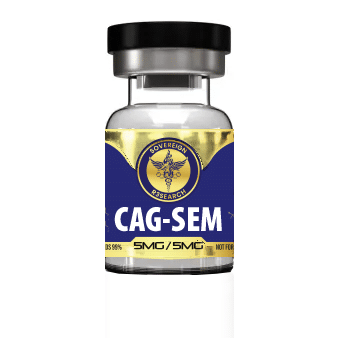

Introduction to Cag-Sem (Research Use Only)
Cag-Sem is an experimental dual-pathway peptide preparation used as a laboratory research tool to explore coordinated signaling between the glucagon-like peptide-1 (GLP-1) receptor and amylin receptor complexes. It combines a long-acting GLP-1 receptor agonist with a long-acting amylin analog, allowing investigators to examine how parallel satiety and metabolic signaling pathways interact.1-3
GLP-1 receptor agonists have been widely studied for their roles in appetite regulation, glycemic control, gastric emptying, and energy balance.¹ Amylin analogs, by contrast, engage hindbrain and brainstem pathways involved in meal termination, gastric signaling, and nutrient sensing.3,4
Combined activation of GLP-1 and amylin receptor pathways has been investigated as a means of producing complementary metabolic signaling, potentially influencing food intake, body weight regulation, and nutrient partitioning.2,5
Cag-Sem is strictly a laboratory-only research material and is not intended for human or veterinary use. It is supplied solely for experimental, analytical, and educational research purposes.
Molecular Structure & Components
Cag-Sem is a heterogeneous peptide preparation consisting of two independently synthesized peptide chains combined in equal mass concentration for experimental receptor-signaling studies.
Component A: GLP-1 Receptor Agonist
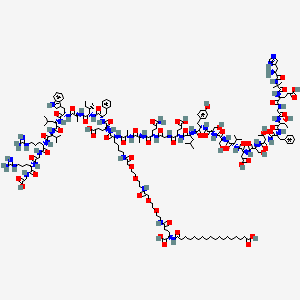
- Sequence: Proprietary GLP-1 analog
- Molecular Formula: C₁₈₇H₂₉₁N₄₅O₅₉
- Molecular Weight: ~4113 g/mol
- CAS Number: 910463-68-2
- PubChem SID: 354702201
GLP-1 receptor agonists are peptide analogs engineered to resist dipeptidyl peptidase-4 (DPP-4) degradation and maintain prolonged receptor engagement through structural modifications such as fatty-acid–mediated albumin binding.6,7
Component B: Cagrilintide (Amylin Analog)
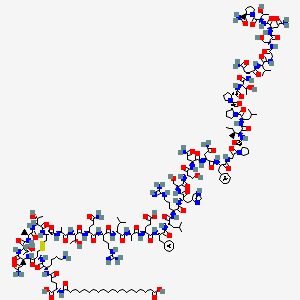
- Sequence: Synthetic amylin analog with disulfide bridge
- Disulfide Bridge: Present (structural stabilization)
- Molecular Formula: C194H312N54O59S2
- Molecular Weight: ~4409 g/mol
- CAS Number: 1415456-99-3
- PubChem SID: 171397054
Cagrilintide is a long-acting amylin analog designed to activate amylin receptor complexes (AMY₁, AMY₂, AMY₃), which are formed by calcitonin receptors associated with receptor-activity-modifying proteins.3,8
Research Highlights
1. Dual-Receptor Signaling and Satiety Integration
Research involving GLP-1 and amylin receptor agonism suggests that these signaling systems may act through complementary neural circuits regulating appetite and energy balance.¹–³
GLP-1 signaling primarily influences hypothalamic appetite regulation and pancreatic endocrine responses, while amylin signaling engages hindbrain nuclei involved in meal termination and gastric feedback.³,⁴
Experimental studies indicate that simultaneous activation of these pathways can produce greater reductions in food intake than activation of either pathway alone, suggesting complementary physiological roles.⁵
2. Nutrient Partitioning and Body-Composition Research
Amylin receptor activation has been associated with changes in nutrient partitioning and reductions in compensatory hyperphagia in experimental models.³,⁴
When studied alongside GLP-1 receptor activation, these mechanisms may help researchers examine lean-mass preservation and fat-mass reduction dynamics during energy-balance interventions.⁵
3. Cardiometabolic and Inflammatory Signaling
GLP-1 receptor agonists have been associated in clinical research with cardiometabolic improvements and reductions in systemic inflammatory markers, including high-sensitivity C-reactive protein.¹,⁹
Studies exploring combined GLP-1 and amylin receptor signaling aim to understand how satiety regulation, metabolic signaling, and inflammatory pathways may interact in complex metabolic systems.²,⁵
4. Pharmacokinetic Context
Long-acting GLP-1 analogs achieve sustained receptor engagement through structural stabilization and albumin binding, which prolong circulating half-life and reduce enzymatic degradation.⁶,⁷
Amylin analogs such as cagrilintide are engineered for extended receptor activation, enabling sustained satiety signaling and facilitating studies examining coordinated metabolic pathways.⁸
Safety and Research Context
Cag-Sem does not have an established safety profile as a combined preparation. Existing safety knowledge is derived from independent studies of GLP-1 receptor agonists and amylin analogs.¹,⁸
Experimental observations involving related compounds suggest that gastrointestinal signaling and appetite suppression represent the dominant biological responses. All findings related to Cag-Sem remain preclinical and exploratory.
References
- Drucker DJ. Mechanisms of action and therapeutic application of glucagon-like peptide-1. Cell Metab. 2018;27(4):740-756. doi:10.1016/j.cmet.2018.03.001
- Garvey WT, Batterham RL, Bhatta M, et al. Efficacy and safety of cagrilintide plus GLP-1 in adults with overweight or obesity. N Engl J Med. 2025;392(3):221-233.
- Lutz TA. Control of food intake and energy expenditure by amylin—therapeutic implications. Int J Obes (Lond). 2010;34(suppl 2):S20-S27.
- Mietlicki-Baase EG, Hayes MR. Amylin and the control of energy balance. Physiol Behav. 2014;136:39-46.
- Roth JD, Erickson MR, Chen S, Parkes DG. GLP-1 receptor and amylin receptor agonism: complementary mechanisms supporting weight loss. Obesity (Silver Spring). 2012;20(5):923-931.
- Lau J, Bloch P, Schäffer L, et al. Discovery of the once-weekly GLP-1 analog GLP-1. J Med Chem. 2015;58(18):7370-7380.
- Knudsen LB, Lau J. The discovery and development of liraglutide and GLP-1. Front Endocrinol (Lausanne). 2019;10:155.
- Mack CM, Soares CJ, Wilson JK, et al. Cagrilintide, a long-acting amylin analogue, for obesity treatment. Diabetes Obes Metab. 2021;23(9):2050-2060.
- Ridker PM. Inflammation, C-reactive protein, and cardiovascular disease. Circulation. 2003;107(3):363-369.