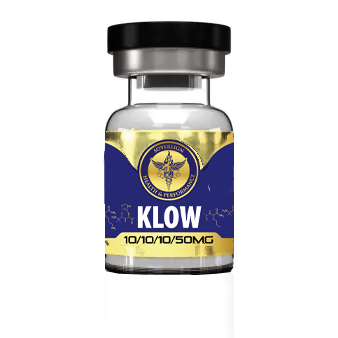
Synergistic Peptide Research: KLOW
A Multi-Axis Blend of BPC-157, Thymosin Beta-4, KPV, and GHK-Cu
Executive Summary
KLOW is a four-peptide research blend combining BPC-157, Thymosin Beta-4 (TB-4), KPV, and GHK-Cu, designed to explore coordinated biological repair across inflammation resolution, angiogenesis, cellular migration, epithelial integrity, and extracellular matrix remodeling.
Rather than targeting a single signaling pathway, KLOW reflects a systems-based repair model. In many chronic or slow-resolving injury states, healing stalls not because repair is impossible, but because one or more biological phases fails to progress—blood flow remains impaired, inflammatory signaling stays elevated, barrier tissues remain compromised, or regenerated tissue remodels poorly.1-3
- BPC-157 and TB-4 primarily support early-stage repair by restoring microvascular function, fibroblast activity, and coordinated cell movement.
- KPV contributes targeted immunomodulatory and epithelial-stabilizing effects, helping tissues disengage from chronic inflammatory signaling.
- GHK-Cu supports later-stage remodeling by influencing gene expression related to collagen synthesis, matrix organization, and tissue maturation.
Together, KLOW represents a multi-phase regenerative research platform, designed to quiet inflammation, restore circulation, guide cell migration, and promote structurally sound tissue rebuilding rather than fragile or fibrotic repair.4-6
1. Tissue Regeneration and Structural Repair
BPC-157 has demonstrated regenerative activity across muscle, tendon, ligament, and epithelial tissues in preclinical models by activating fibroblasts, modulating VEGF and FGF signaling, and enhancing collagen deposition during early repair phases.7-9
Thymosin Beta-4 complements this effect by regulating actin dynamics and cytoskeletal organization, enabling repair cells to migrate efficiently into damaged regions and align appropriately during reconstruction.10-12
GHK-Cu supports later-stage repair by influencing gene expression associated with collagen synthesis, elastin formation, and proteoglycan balance—key determinants of tissue strength and elasticity.13-15
While KPV is not a structural peptide, it indirectly enhances regeneration by reducing inflammatory interference that disrupts fibroblast signaling and epithelial turnover.1-6
Together, these peptides form a sequential repair loop:
- Early activation and vascular support (BPC-157, TB-4)
- Inflammatory resolution and barrier stabilization (KPV)
- Tissue maturation and remodeling (GHK-Cu)
2. Angiogenesis and Microvascular Support
Adequate blood supply is a limiting factor in many chronic injuries.
- BPC-157 promotes endothelial survival, nitric oxide signaling, and VEGFR-mediated angiogenesis.17-19
- TB-4 enhances endothelial cell migration and capillary formation through actin-dependent mechanisms.20
- GHK-Cu has been shown to upregulate angiogenic gene expression while supporting extracellular matrix organization around developing vessels.21-23
By improving microvascular density and stability, KLOW supports sustained oxygen and nutrient delivery—one of the strongest predictors of repair velocity and tissue durability.
3. Inflammation Modulation and Barrier Integrity
Failure to resolve inflammation prevents tissues from progressing into the remodeling phase.
- KPV, a C-terminal fragment of α-MSH, interacts with melanocortin receptors to downregulate NF-κB signaling and reduce pro-inflammatory cytokine release, particularly in epithelial tissues.24-26
- BPC-157 stabilizes nitric oxide signaling and inflammatory mediator balance, demonstrating organ-protective effects in multiple preclinical models.27
- TB-4 has been shown to influence macrophage polarization toward the M2 (pro-repair) phenotype.28
- GHK-Cu further supports inflammation resolution by modulating oxidative stress and repair-associated gene expression.29
This coordinated modulation helps tissues exit prolonged inflammatory states and re-enter productive healing cycles.
4. Cellular Migration and Cytoskeletal Coordination
Effective healing requires accurate cell movement and spatial organization—not just proliferation.
- TB-4 governs actin polymerization, enabling fibroblasts, keratinocytes, and endothelial cells to migrate directionally toward injury sites.30
- BPC-157 enhances focal adhesion signaling (FAK–paxillin pathways), improving cell attachment, survival, and mechanical resilience.31
- GHK-Cu influences integrin expression and matrix-cell communication, supporting orderly tissue alignment during remodeling.32
By reducing inflammatory disruption, KPV indirectly preserves cytoskeletal signaling fidelity during repair.
5. Extracellular Matrix Remodeling and Long-Term Tissue Quality
Many tissues “heal” structurally but remain vulnerable due to poor matrix organization.
GHK-Cu plays a central role in this phase by regulating genes associated with:
- Collagen I / III balance
- Elastin synthesis
- Matrix metalloproteinase (MMP) regulation33-35
When combined with BPC-157 and TB-4, which accelerate early repair and vascularization, GHK-Cu helps ensure regenerated tissue matures into functionally resilient structures rather than scar-dominant tissue.
6. Future Areas of Research
Ongoing and emerging research is exploring KLOW-like multi-peptide systems in contexts such as:
- Chronic tendon and ligament injuries resistant to standard recovery timelines
- Epithelial barrier dysfunction and mucosal repair
- Post-inflammatory tissue remodeling
- Age-related decline in healing efficiency
- Recovery environments where inflammation resolution and structural repair must proceed concurrently36-38
Early findings suggest that multi-axis peptide systems addressing inflammation, perfusion, migration, and remodeling simultaneously may outperform isolated peptide approaches by restoring the full biological sequence of healing.
References
- Gurtner GC, et al. Wound repair and regeneration. Nature. 2008.
- Eming SA, et al. Inflammation in wound repair. J Invest Dermatol. 2007.
- Wynn TA, Vannella KM. Macrophages in tissue repair. Immunity. 2016.
- Sikiric P, et al. Curr Pharm Des. 2020.
- Goldstein AL, et al. Ann N Y Acad Sci. 2012.
- Pickart L. J Biomater Sci Polym Ed. 2008.
- Staresinic M, et al. J Physiol Pharmacol. 2003.
- Chang CH, et al. J Orthop Res. 2019.
- Seiwerth S, et al. Curr Pharm Des. 2020.
- Malinda KM, et al. J Cell Sci. 1997.
- Huff T, et al. Ann N Y Acad Sci. 2002.
- Sosne G, et al. FASEB J. 2002.
- Pickart L, Margolina A. Biomed Res Int. 2015.
- Maquart FX, et al. Connect Tissue Res. 1988.
- Siméon A, et al. FEBS Lett. 2000.
- Catania A, et al. Peptides. 2010.
- Staresinic M, et al. J Physiol Pharmacol. 2003.
- Vukojevic J, et al. Growth Horm IGF Res. 2018.
- Seiwerth S, et al. Acta Pharmacol Sin. 2014.
- Bock-Marquette I, et al. Nature. 2004.
- Pickart L. Clin Dermatol. 2008.
- Siméon A, et al. Pathol Biol. 1999.
- Kang Y, et al. Int J Mol Sci. 2020.
- Getting SJ, et al. J Immunol. 1999.
- Catania A. Endocr Rev. 2004.
- Brzoska T, et al. FASEB J. 2008.
- Seiwerth S, et al. Curr Pharm Des. 2020.
- Sosne G, et al. Exp Eye Res. 2004.
- Pickart L, Thaler MM. J Cell Biochem. 1973.
- Huff T, et al. Ann N Y Acad Sci. 2002.
- Chang CH, et al. J Orthop Res. 2019.
- Siméon A, et al. FEBS Lett. 2000.
- Pickart L, Margolina A. Biomed Res Int. 2015.
- Maquart FX, et al. Connect Tissue Res. 1988.
- Siméon A, et al. Pathol Biol. 1999.
- Jelovac N, et al. Acta Pharmacol Sin. 2021.
- Eming SA, et al. Sci Transl Med. 2017.
- Wynn TA. Nat Rev Immunol. 2008.