


Kisspeptin — Research Overview
Kisspeptin (originally identified as metastin) is a peptide product of the KISS1 gene that has been widely studied for its role in the regulation of the reproductive axis.¹ The information below summarizes findings from published scientific literature investigating kisspeptin signaling pathways.
Initially discovered in 1996 as a metastasis suppressor gene in melanoma, the KISS1 peptide system was later found to play a central role in neuroendocrine control of reproductive signaling.²
Kisspeptin binds to its cognate G protein-coupled receptor, KISS1R (formerly GPR54), which is highly expressed on gonadotropin-releasing hormone (GnRH) neurons in the hypothalamus.³ Activation of this pathway has been shown in experimental studies to stimulate GnRH secretion, leading to downstream release of luteinizing hormone (LH) and follicle-stimulating hormone (FSH) from the pituitary gland.
Unlike mitochondrial-targeted peptides such as SS-31 that interact primarily with membrane lipids, kisspeptin functions as a neuroendocrine signaling ligand involved in hormonal communication within the hypothalamic-pituitary-gonadal (HPG) axis.
Research literature frequently describes kisspeptin signaling as a key upstream regulator involved in activation of the reproductive endocrine axis during puberty.
Executive Summary
Kisspeptin is a neuropeptide involved in the regulation of reproductive hormone signaling.
Published research has examined its role in:
- Regulation of the Hypothalamic-Pituitary-Gonadal (HPG) axis¹
- Neuroendocrine processes associated with pubertal development³
- Coordination of ovulatory hormone signaling and estrogen feedback⁴
- Experimental models investigating tumor metastasis suppression²
- Brain signaling related to emotional and behavioral processing, including responses to romantic and sexual stimuli⁵
Kisspeptin functions as a KISS1R receptor agonist, and research into this signaling pathway focuses primarily on neuroendocrine communication and reproductive hormone regulation.
Key Actions
GnRH Pulse Generation
Experimental studies demonstrate that kisspeptin signaling strongly activates GnRH neurons. This pathway integrates internal physiological signals—including metabolic status, hormonal feedback, and circadian inputs—that influence the timing and frequency of GnRH pulses.¹
These pulsatile signals regulate LH and FSH secretion and are central to reproductive endocrine signaling.
Role in Pubertal Activation
Research has shown that kisspeptin signaling is required for normal pubertal development. Mutations in the KISS1R gene have been associated with idiopathic hypogonadotropic hypogonadism, demonstrating that intact signaling through this pathway is necessary for activation of the reproductive axis.³
Experimental evidence indicates that increased KISS1 expression within the hypothalamus occurs during the transition into puberty.
Ovulatory Hormone Signaling
In females, kisspeptin neurons located in the rostral periventricular area of the third ventricle (RP3V) are involved in mediating estrogen positive feedback that contributes to the pre-ovulatory LH surge.⁴
This signaling mechanism allows estrogen produced by developing ovarian follicles to influence the neuroendocrine events associated with ovulation.
Metabolic–Reproductive Integration
Kisspeptin neurons respond to several metabolic signaling molecules, including leptin, ghrelin, and insulin.⁶
Through these interactions, researchers believe the brain integrates information about energy availability and nutritional status with reproductive hormone signaling. Conditions of severe energy deficiency—such as malnutrition or excessive exercise—have been associated with reduced activity in this pathway.
Non-Reproductive Brain Signaling
Kisspeptin receptors have also been identified in limbic brain regions including the amygdala and hippocampus. Research investigating kisspeptin administration in humans has examined how this signaling pathway may influence brain responses to emotional, romantic, and sexual stimuli.⁵
🧬 What Is Kisspeptin?
Kisspeptin peptides are derived from a 145-amino-acid precursor protein encoded by the KISS1 gene. Proteolytic processing produces several biologically active fragments, including:
- Kisspeptin-54 (Metastin)
- Kisspeptin-14
- Kisspeptin-13
- Kisspeptin-10
All variants share a conserved C-terminal RF-amide sequence required for binding and activating the KISS1R receptor.¹
Kisspeptin-54 was the first isoform identified in metastasis research, while shorter fragments such as Kisspeptin-10 are commonly used in experimental studies due to their high potency in stimulating gonadotropin signaling.
Core Research Areas
🍼 Reproductive Endocrinology Research
Clinical and translational research has explored kisspeptin signaling in the context of reproductive endocrinology and assisted reproduction models. Some studies have investigated the use of kisspeptin administration as a tool to study ovulatory hormone signaling during IVF-related research.⁷
🧒 Pubertal Development Research
Kisspeptin signaling is widely studied for its role in the neuroendocrine mechanisms associated with the onset of puberty. Researchers continue to examine this pathway in both precocious puberty and delayed puberty, and kisspeptin stimulation testing has been explored in research settings evaluating hypothalamic-pituitary-gonadal axis function.³
🧠 Neuropsychology Research
Human neuroimaging studies have investigated how kisspeptin signaling influences brain activity in regions associated with reward, emotion, and sexual processing. Research in this area continues to explore how kisspeptin affects neural responses to romantic and sexual cues.⁵
🦀 Oncology Research (Metastasis Signaling)
The KISS1 gene was originally discovered as a metastasis suppressor in melanoma. Experimental research has shown that KISS1 signaling may reduce cancer cell migration and invasion in several tumor models, including melanoma and breast cancer.²
The clinical significance of these findings remains an active area of research.
🧪 Mechanistic Insights
Activation of KISS1R, a rhodopsin-like G protein-coupled receptor, initiates intracellular signaling primarily through the Gq/11 pathway.
Experimental research indicates that kisspeptin signaling can:
- Activate phospholipase C
- Increase intracellular calcium
- Depolarize GnRH neurons
- Stimulate downstream GnRH release
Kisspeptin neurons also interact with KNDy neurons, a hypothalamic network containing Kisspeptin, Neurokinin B, and Dynorphin.
This neuronal system located in the arcuate nucleus is widely believed to function as the GnRH pulse generator, coordinating rhythmic release of reproductive hormones.⁸
Molecular Details (Kisspeptin-10)
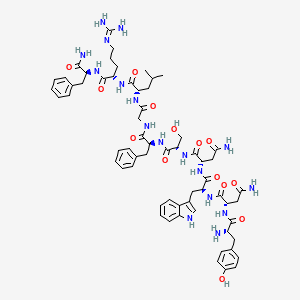
Sequence:
Tyr-Asn-Trp-Asn-Ser-Phe-Gly-Leu-Arg-Phe-NH₂
Molecular Formula:
C₆₃H83N17O14
Molecular Weight:
1302.4 Da
CAS Number:
374675-21-5
References
- Oakley AE, Clifton DK, Steiner RA. Kisspeptin signaling in the brain. Endocr Rev. 2009;30(6):713-743.
- Ohtaki T, Shintani Y, Honda S, et al. Metastasis suppressor gene KiSS-1 encodes peptide ligand of a G-protein-coupled receptor. Nature. 2001;411:613-617.
- Seminara SB, Messager S, Chatzidaki EE, et al. The GPR54 gene as a regulator of puberty. N Engl J Med. 2003;349(22):2114-2127.
- Clarkson J, Herbison AE. Postnatal development of kisspeptin neurons in the mammalian hypothalamus. Endocrinology. 2006;147(12):5817-5825.
- Comninos AN, Demetriou L, Wall MB, et al. Kisspeptin modulates sexual and emotional brain processing in humans. J Clin Invest. 2017;127(2):709-719.
- Quennell JH, Howell CS, Roa J, et al. Leptin deficiency and diet-induced obesity reduce hypothalamic kisspeptin expression. Endocrinology. 2011;152(4):1541-1550.
- Jayasena CN, Abbara A, Comninos AN, et al. Kisspeptin-54 triggers egg maturation in women undergoing IVF treatment. J Clin Invest. 2014;124(8):3667-3677.
- Lehman MN, Coolen LM, Goodman RL. Kisspeptin/Neurokinin B/Dynorphin (KNDy) cells of the arcuate nucleus: a central node in the control of GnRH secretion. Endocrinology. 2010;151(8):3479-3489.